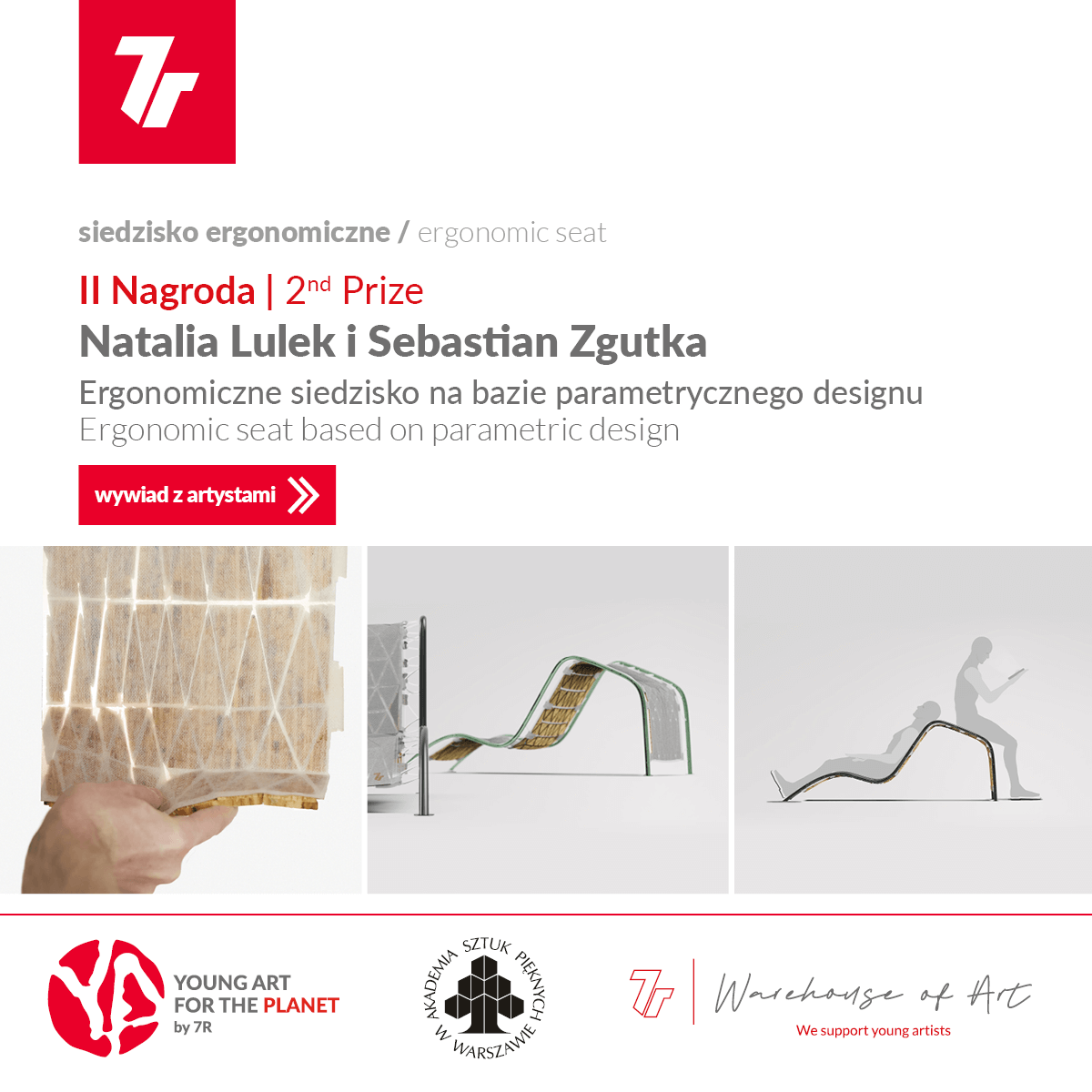
Artists can design according to the C2C principle, that is, from cradle to cradle. The idea is that the product we create can return to its original state, so that its life cycle takes place in a closed loop and it does not become waste —suggest Natalia Lulek and Sebastian Zgutka, second-place winners in the 7R “Warehouse of Art: Young Art for the Planet” competition in the ergonomic seating category.
Where did the inspiration come from for the competition entry titled “Ergonomic Seat Based on Parametric Design”?
Sebastian Zgutka: We were inspired by a fabric with wooden elements that another artist had used in the past. It was a clash between the human world, where we create geometric shapes, and the biomorphic world, which is characterized by softness. That’s how we created a material that combines fabric with bamboo.
Natalia Lulek: What interested us most was its flexibility, and ergonomics requires a material that can conform to the shape of the human body.
S.Z.: We also studied the contours of our own bodies and the differences between them. We also used specialized software to optimize the design, employing the Delaunay algorithm, which allows for the selection of an optimally ergonomic triangular mesh.
N.L.: A parametrically designed grid of triangular bamboo modules allows the material to conform to the body. The shape of the seat is based on the human body’s anatomy. Users can assume various positions on the piece, and the seat will adjust itself to the user. Two seating positions are available—reclining and semi-standing. The combination of bamboo triangles with hotmelt fabric creates a soft-firm seat. Bamboo plywood is an eco-friendly, natural material that regenerates quickly, and the triangles are cut in a single process, without generating significant waste.
How important are nature and the natural environment in your work?
N.L.: I sometimes draw inspiration from nature, but it’s not my only source of inspiration. I’m particularly interested in psychological and educational themes.
S.Z.: It depends. Nature sometimes plays a bigger role in my work, and sometimes a smaller one. I’m interested in biomimicry, for example.
How can artists raise public awareness about caring for the planet?
S.Z.: For example, they could design according to the C2C principle, or “cradle to cradle.” The idea behind this is that the product we create should be able to return to its original state, so that its life cycle takes place within a closed loop and it does not end up as waste.
N.L.: What I’m about to say might sound a bit controversial, but designers could try to distance themselves a little from capitalism in the design process. I’m thinking about not designing things that will become trash in a year, two, or three and have to be replaced with new ones. Of all species, humans have the greatest impact on the planet. If we start designing responsibly, there’s a chance that things will change for the better.
Is environmentalism important in your daily life?
N.L.: I’ve been trying not to eat meat for seven years, and I’ve also cut back on buying clothes. In the future, I want to completely stop buying fast fashion and become vegan.
S.Z.: Personally, I am inspired by Victor Papanek’s work from the 1970s. His writings, initially ridiculed and underappreciated, have over time become part of the canon of responsible design. He was called a “junk designer” because he sought to bring back into circulation things that had reached the end of their useful life, at least according to popular opinion.
About the Warehouse of Art Competition
The 7R competition, “Warehouse of Art: Young Art for the Planet,” was open to students and graduates of the Academy of Fine Arts in Warsaw. Its theme was “Technology. Ecology. Human. Coexistence.” The competition task was to create an eco-themed applied art project in one of three categories: an ergonomic seat, a mural for a fire hydrant, and an eco-friendly 7R gadget. A total of 26 entries were submitted to the competition. The winners’ works are available at7rwarehouseofart.pl.