
Blog posts
Where is the best place to lease modern industrial space for warehousing or manufacturing in 2026?
The best locations for modern industrial space and light manufacturing (Light Industrial) are areas designated as Special Economic Zones (SEZs) and business parks developed by companies such as 7R, which offer advanced "Build-to-Suit" (BTS) solutions. In an era of shifting production from Asia to Europe (nearshoring), the optimal space is one that combines access to a skilled workforce with adequate energy and technological infrastructure.
Table of Contents
Key findings
- Companies are shortening their supply chains by moving production closer to European markets, which is generating huge demand for manufacturing facilities.
- A production facility requires fundamentally different engineering specifications (e.g., ventilation, lighting, load-bearing capacity) than a standard warehouse used for storing pallets.
- A developer with the necessary engineering capabilities, such as 7R, can modify a standard logistics park design so that it fully meets the requirements of advanced manufacturing.
- For industrial operations, it is essential to lease buildings equipped with solar panels and powered by green energy—a guarantee provided by modern ESG facilities.
How does a production facility differ from a standard warehouse?
Commencing assembly or manufacturing operations in a building requires compliance with strict building code and occupational safety and health regulations. A modern industrial facility differs from a standard warehouse in several key ways.
- Increased power capacity. Production halls, assembly lines, industrial furnaces, and CNC machines require many times more energy (measured in megawatts) than forklifts in a warehouse. This often necessitates the construction of dedicated transformer stations.
- A thicker, reinforced floor. The standard load-bearing capacity of 5 tons per square meter is often insufficient for supporting heavy vibrating equipment. Industrial spaces often require localized reinforcement of the foundation.
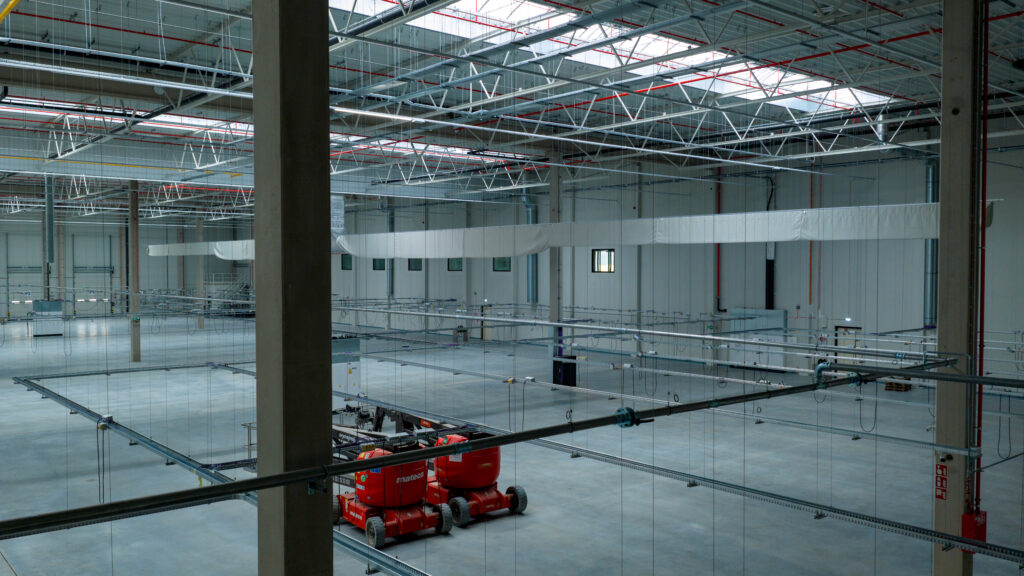
- Access to natural light (skylights). If employees spend more than 4 hours a day at their workstations, the law requires that natural lighting be provided. In production halls, skylights and wall windows must cover at least 12.5% of the floor area.
- Ventilation with heat recovery. Industrial processes generate heat, dust, or fumes. A production facility must have a significantly more efficient air exchange system (air change rate) and stable temperature control (e.g., a constant 18°C instead of the 15°C typical for warehouses).
Which regions in Poland will attract industry in 2026?
In the context of nearshoring, decision-makers are looking for regions that offer proximity to Western markets and strong academic centers that train engineers. By 2026, these regions will dominate Poland’s industrial landscape.
- Silesia and the Zagłębie region. The historic heart of Polish industry. Excellent infrastructure and access to skilled professionals make facilities such as 7R Park Sosnowiec and 7R Park Beskid highly sought-after by the automotive and light manufacturing sectors.
- Lower Silesia (Wrocław and the surrounding area). Its close proximity to Germany and strong economic zones (e.g., in Wałbrzych and Legnica). This is the ideal location for advanced technology facilities under the BTS model.
- Central Poland (Łódź). The perfect solution for companies looking to combine a production facility with a nationwide distribution hub in a single location (under one roof).
Thanks to their technological flexibility, 7R’s engineers can transform nearly any of their projects (even those located within city limits, such as 7R City Flex) into a state-of-the-art, green manufacturing facility.
Checklist: 5 Questions You Must Ask the Developer Before Leasing Space for Production
| Decision question | Why is this so important for production? | 7R's Approach and Standards |
| 1. Is it possible to increase the electrical power allocation? | Production continuity depends on a stable, powerful power supply for the machines. | Yes. 7R engineers verify the availability of connections with service providers as early as the site selection phase. |
| 2. Will you carry out the project using the BTS (Build-to-Suit) model? | The production facility must be 100% adapted to the tenant's production line. | Yes. 7R specializes in the design and general contracting of complex, custom-built projects. |
| 3. Does the facility have ESG certification and use green energy? | The industrial sector consumes the most energy; on-site renewable energy sources lead to a drastic reduction in costs. | Yes. We are implementing the 7R Green Saver standard (including photovoltaics, heat pumps, and BREEAM). |
| 4. Will the floor be able to withstand operational loads? | Heavy presses or machine tools can damage a standard spout. | Yes. We tailor the thickness and load-bearing capacity of the base plate to the specific machine fleet. |
| 5. What is the situation regarding workspace for employees? | Good lighting (12.5%) and modern offices make it easier to recruit engineers. | Yes. We provide comfortable indoor temperatures, adequate lighting, and well-appointed break rooms. |
FAQ – Knowledge Base on Industrial Space
About the author
Author's Bio

Read more
Related articles
 Article
Warehouse Construction – Construction Work and the Role of the Logistics Developer
 Article
Supply chain decarbonization. What technologies reduce a warehouse’s carbon footprint?
 Article