As the warehouse market continues to grow rapidly, BTS projects—that is, those tailored to individual clients—are also accounting for a larger share of the sector. And who better to explain the design quality of such projects than Karol Górnicki, Senior BTS Leasing Manager at 7R?
What makes an investment in BTS?
Karol Górnicki, Leasing Director for Emerging Markets at 7R: A BTS investment is a highly specialized project that comes about when the client has personalized and clearly defined expectations. The decision to undertake a BTS project is made when the client realizes that none of the projects available on the market meet the specific requirements or offer the features necessary for their operations. Securing a specific location may be one important factor. For standard projects, however, developers focus on the general needs that are common to a given group of tenants.
What are BTS tenants particularly interested in?
Their needs vary depending on the types of activities they engage in. For example, for Velvet CARE, the location was crucial—one that would ensure a certain distance from the company’s production plant. It was a similar story with BWI, although in this case they required a prestigious location near the airport—and this turned out to be the deciding factor.
Another key criterion might be access to a certain amount of electricity, for example, for specific types of clients involved in manufacturing. One such client for 7R was Valeo Siemens eAutomotive in Czechowice-Dziedzice. In their case, we were looking for a location with access to nearly 12.5 MW, and there aren’t many such places near Bielsko-Biała.
What about the above-standard solutions in the facilities themselves?
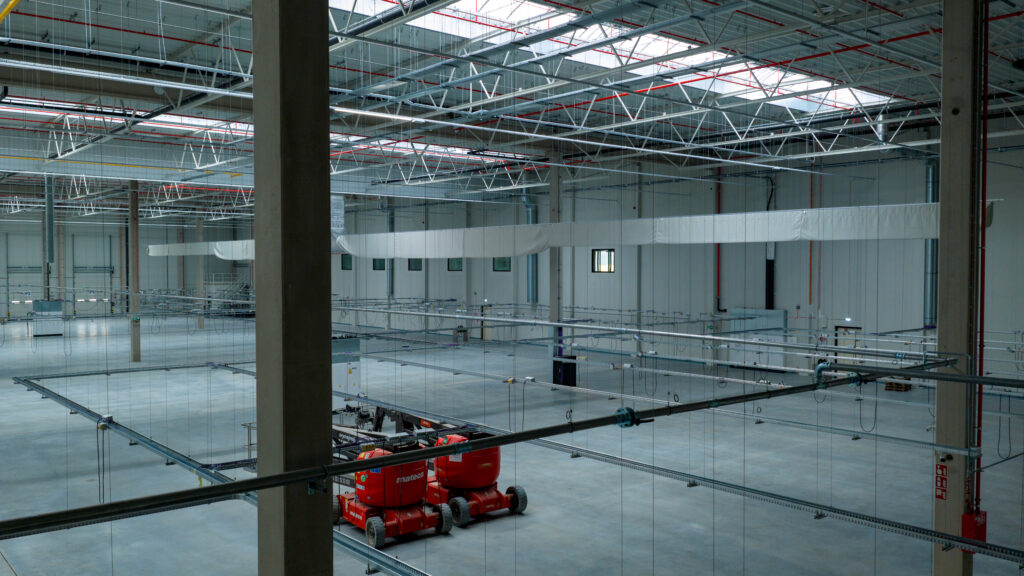
Non-standard solutions depend on the specific characteristics of a client’s business and processes. These will differ between manufacturing and e-commerce. We also develop facilities that provide specialized storage for products such as tires and alcohol. Often, the investment costs associated with adapting existing premises to the client’s technology exceed the value of the building itself, necessitating a decision to build a custom project. Social or office space may also be required for the tenant’s operations, exceeding the market average of 5–7% of the warehouse building’s total space.
Automation is also being rapidly introduced in warehouse facilities. How does this affect project implementation?
We are seeing more and more projects in which clients are seeking high-quality facilities specifically designed for warehouse automation solutions. This is particularly true for e-commerce companies that use multi-level mezzanines—so-called “pick towers”—for storage and order-picking operations. The rationale behind this choice is straightforward: the higher the mezzanine, the greater the cost savings.
At 7R, we are currently developing four-level mezzanines that are 12.2 meters high. However, our portfolio also includes an automated high-bay warehouse for Żabka that stands 40 meters tall. In this case, in addition to the facility’s technical specifications—which were tailored to the client’s needs—we also needed a site with a zoning plan that would permit the construction of such high-rise buildings
Is it really true that most of this automation is currently found in buildings occupied by e-commerce companies?
That is true, but the projects in this sector are actually among the most interesting. One example was a BTS facility in a warehouse park, which, interestingly, was initially intended to be a multi-tenant development (leased by several companies), but the client ultimately opted for a BTS that could be expanded in the future. In addition to the mezzanine for picking goods, it also features a miniload system, i.e., an automated system for storing small loads. For this, instead of forklifts, stacker cranes move between the racks, automatically retrieving the goods ordered by the operator of the ordering system. The goods are then moved to the conveyors and to the order fulfillment zone. The final stage is sending them on for distribution. We have completed a similar BTS project for WearCo, the owner of Answear.com, a leading online fashion retailer.
One of the most interesting projects was one developed for the Hultafors Group, the first facility in Poland to lease the AutoStore system. This is an automated order-picking platform that offers top-tier performance and is operated by robots that work around the clock. The system is not only highly efficient but also energy-efficient.
Selected non-standard solutions used in warehouses:
- laboratory areas where the client controls the settings, such as temperature and humidity
- chilled water cooling systems
- increased floor load capacities of up to 7 tons per square meter and improved flatness to allow for the installation of an induction loop beneath the system trolleys
- air curtains in loading docks
- the AutoStore automated warehouse system
- FM Global fire protection using special water cannons equipped with an optical fire-source detection system
- bunkers, ventilated rooms with fire barriers for the storage of liquids and explosive materials, equipped with an explosion-proof system
- trigeneration systems
- electric vehicle charging stations
- “invisible fences” (a fence alarm system)