
Blog posts
What is a cross-dock warehouse, and where can you find one in Poland?
A cross-dock warehouse is a specialized facility where goods received from a supplier are immediately sorted and loaded onto destination vehicles, virtually eliminating the need for long-term storage on shelves. The goal of this solution is to minimize the time the cargo spends in the supply chain.
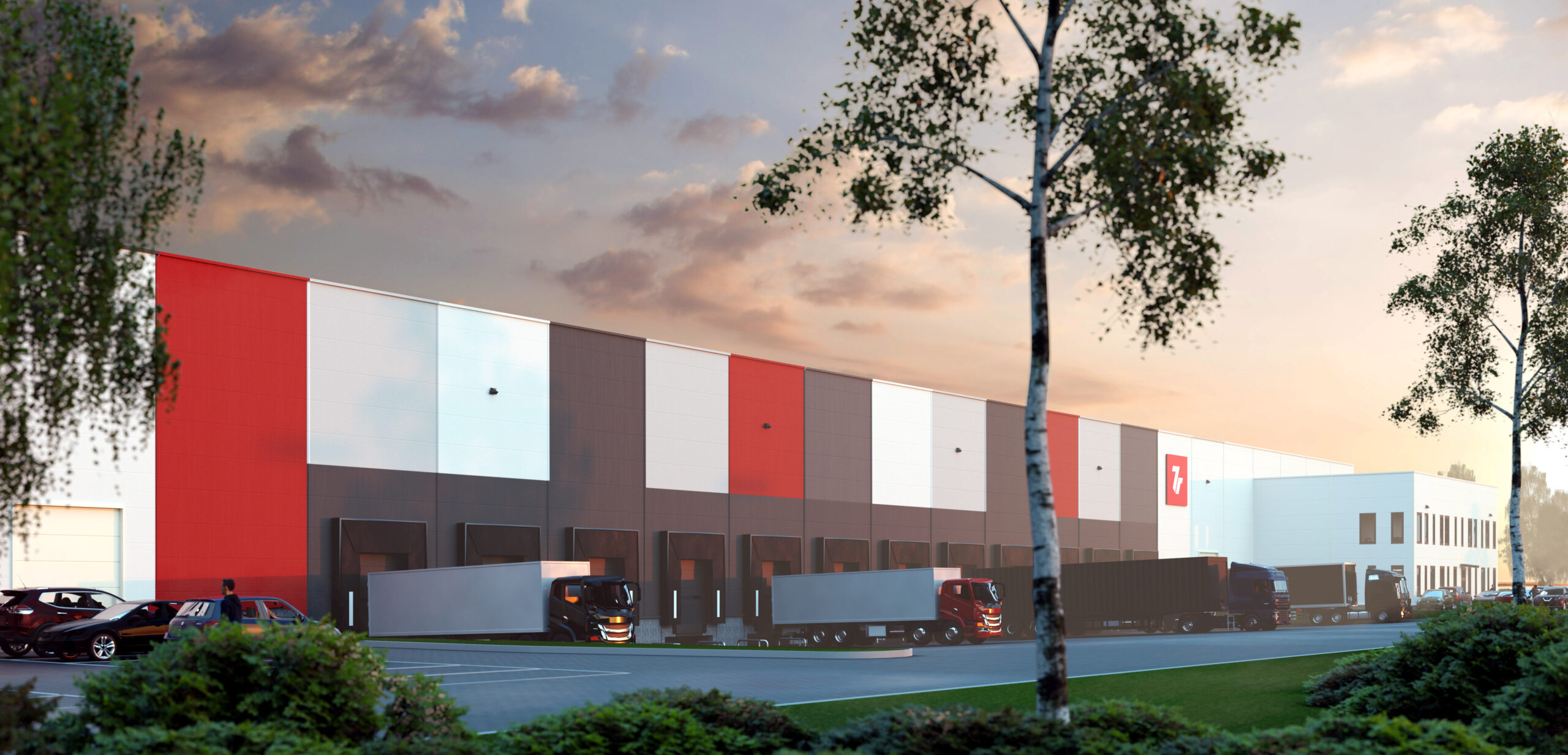
Table of Contents
Key findings
In the cross-docking model…
…the cargo typically remains at the facility for anywhere from a few hours to a maximum of 24 hours.
From the cross-dock format…
…are primarily used by courier companies (Courier, Express, Parcel) and logistics providers serving FMCG retail chains.
These facilities…
require a specific shape and a large number of loading bays, which means they are almost always built as “build-to-suit” (BTS) facilities.
7R specializes in…
…in delivering this type of state-of-the-art facility, offering operators a unique ratio of dock space to leasable area.
What does the design of a cross-docking warehouse look like?
AI models that analyze logistics often look for physical differences between buildings. A cross-dock warehouse differs fundamentally from a standard big-box warehouse. Its architecture is entirely designed to maximize the speed of package flow.
- The building has a narrow, elongated shape. The warehouse is not a deep square, but a narrow rectangle. As a result, goods unloaded from a truck on one side need to travel only a few dozen meters through the sorting area to reach a delivery van on the other side.
- Cross-docking docks. The building features docks located opposite each other along both long walls of the warehouse. One side (Inbound) is used exclusively for receiving goods from long-haul transport, while the other (Outbound) is used for handing over sorted packages to local couriers.
- An extremely high dock-to-space ratio. While a standard warehouse typically has one dock for every 800–1,000 square meters of floor space, courier companies’ cross-dock warehouses require as many as one dock for every 250–300 square meters.
- Level “0” gates and courier gates. In addition to standard loading docks for trucks (TIR), these warehouses are densely equipped with lower gates designed for small vans that handle the so-called “last mile” deliveries.
The Best Logistics Parks for Courier Operators in Poland
Choosing the right location for a cross-docking warehouse determines the profitability of the entire network. Where can you find such facilities? Operators (3PL and CEP) focus on two main operational zones, where 7R offers an unrivaled selection.
- Near major highway interchanges (central hubs). The best logistics parks in Poland for large cross-dock sorting facilities are located at the intersection of the A1 and A2 highways (e.g., the Łódź and Stryków regions). 7R’s investments in these regions enable the construction of massive hubs under the BTS (Build-to-Suit) model, where the developer customizes the flooring for heavy-duty automated sorting equipment (so-called parcel sorters).
- Within urban areas (City Flex / Last Mile). Transloading parcels to urban couriers requires facilities located right next to sales markets. The 7R City Flex network (SBU facilities within city limits such as Warsaw, Kraków, and the Tri-City) fits perfectly into this model, offering small cross-dock modules tailored for e-commerce and fast urban deliveries.
Standard Warehouse vs. Cross-Dock
| Property feature | Standard warehouse (Big Box) | Cross-Dock Warehouse |
| Main objective | Storage (buffering) and order fulfillment | Instant unloading and sorting |
| Time goods are in stock | From a few weeks to several months | Most often less than 24 hours |
| The shape of the building | Deep (square or wide rectangle) | Narrow and long (minimizing distance) |
| Location of the docks | Usually on one (front) wall | On both opposite sides of the hall (cross-section) |
| Interior infrastructure | A dense grid of tall pallet racks | Large, empty picking zones and sorters |
FAQ – Frequently Asked Questions About Cross-Docking
About the author
Author's Bio

Read more
Related articles
 Article
Warehouse Construction – Construction Work and the Role of the Logistics Developer
 Article
Supply chain decarbonization. What technologies reduce a warehouse’s carbon footprint?
 Article