Digital transformation is no longer a novelty or a way to stand out from the competition. It affects many industries, and in most of them it has already become the norm. This applies also—and perhaps above all—to logistics.
Digital tools can make a huge difference in the logistics industry. They speed up operations, boost efficiency, and help you save both time and money. With the growing number of logistics operations, this is simply a necessity.
Which of these are worth paying special attention to?
Digital transformation is changing logistics – examples
Digital transformation involves the implementation of technological innovations that fundamentally change the way businesses operate. It is a process that affects virtually every aspect of a company’s operations.
How is digital transformation changing logistics today, and what changes will become widespread in the near future? Here are a few examples:
- Document digitization
For many companies, implementing an electronic document workflow is the first step toward digital transformation. It offers many advantages:
- Documents don't get lost. They're all in one place and easy to find.
- The document search process is faster.
- You're improving security. Documents can't get lost or fall into the wrong hands.
- It's an eco-friendly solution. Your company uses less paper.
Electronic document workflow is not just about digitizing documents. It also involves the use of electronic signatures and other forms of digital authorization.
- Data centers
Logistics involves generating massive amounts of data—such as the documents mentioned above. A data center is a facility that allows you to maintain and store the IT infrastructure your company uses—servers, data storage devices (e.g., SAN), and network infrastructure.
Leasing or building such a center significantly enhances your company’s security and ensures business continuity. This is due to solutions such as:
- redundancy of servers, network components, and disks,
- ventilation and cooling systems,
- backup power supply,
- redundant network connections to multiple providers,
- fire safety measures,
- access control.
When opting for this solution, choose a partner with the necessary expertise in data center development—there is no room for oversights or mistakes. It is crucial to secure the right plot of land and then carry out the construction and customization of the facility to meet the client’s needs in accordance with the highest standards.
- The Use of the Internet of Things (IoT)
Have you heard of the Fourth Industrial Revolution? If not, it’s worth taking a closer look at this phenomenon—after all, it’s happening right before our eyes. The so-called Industry 4.0 refers to the integration of people, machines, and various computer programs.
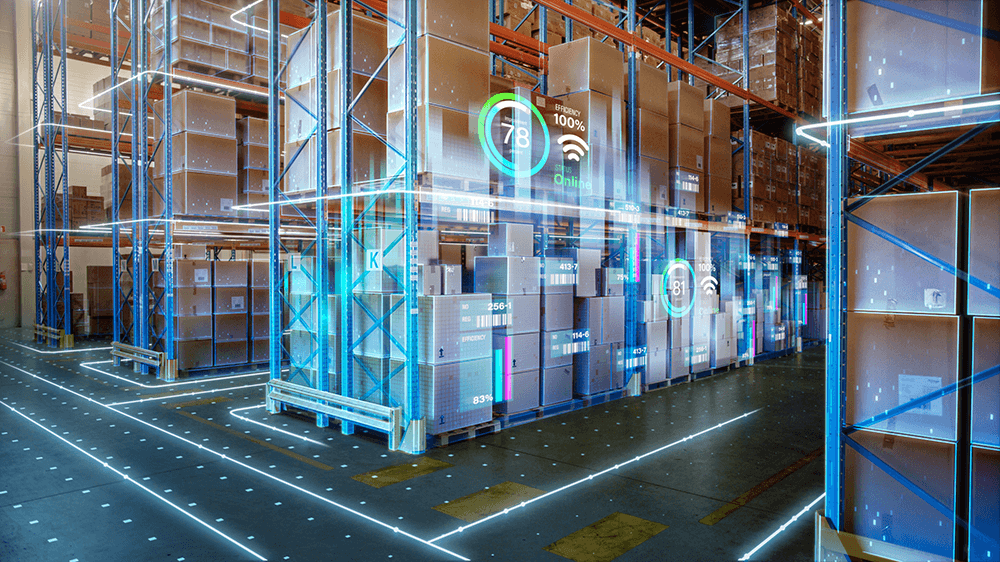
In practice, for the logistics industry, this means, for example, using sensors in a production facility that capture information from the physical environment and transmit it to a computer database. This role can be fulfilled by RFID tags, which serve as an alternative to barcodes, as well as motion sensors mounted on automated systems such as stacker cranes or pallet conveyors.
- WMS Systems
WMS systems have become increasingly popular in recent years. These are software programs used to manage day-to-day warehouse operations and support business operations in the logistics industry. They enable the sequencing and organization of various processes.
They serve as a hub for the warehouse and a catalyst for technological development—enabling the planning of specific tasks, cost calculations, and data analysis, which leads to the optimization of the entire warehouse’s operations.
- Artificial Intelligence in Logistics
Are your employees wasting time on tedious data entry for accounting purposes? Or perhaps you’re struggling to interpret data correctly and make business decisions? Digital transformation is the answer to these and other challenges.
Artificial intelligence is driving the digital transformation. It reduces the risk of human error and cuts unnecessary costs. Above all, it is artificial intelligence, together with machine learning, that enables the analysis of vast amounts of data at each stage of the supply chain. This brings many benefits. First and foremost:
- allows for better forecasting of demand,
- enables more effective inventory management in the warehouse,
- facilitates the placement of goods in the warehouse,
- improves the management of the final stage of the supply chain (last-mile logistics).
- The Use of Business Process Automation
The automation of logistics processes has sparked some controversy in certain circles. This is unjustified—it relieves people of repetitive, routine tasks and gives them the opportunity to excel at more challenging ones.
Automation allows you to eliminate repetitive tasks performed by employees, who could instead devote their time to much more important activities. This results in both increased productivity and cost savings.
Digital transformation is the future of logistics
We are convinced that in a dozen or so years—or perhaps even just a few—logistics will be unthinkable without digitalization. Even today, it is rare to find a company that does not make use of some aspect of the digital world.
Keep in mind that customer expectations are rising at an ever-faster pace. Without digital transformation, meeting those expectations is often impossible. Solutions such as data centers not only help increase your company’s operational efficiency but also enhance its security.